Last updated: July 2026
On Pantelleria, the volcanic island between Sicily and Tunisia, most visitors do not stay in a hotel. They rent a dammuso: a low house of black lava stone with walls a metre thick and a white domed roof shaped to catch rain and channel it into a cistern. They were built to survive wind, heat and drought without machinery, and they still do it — the interior of a dammuso in August is startlingly cool.
This page covers what a dammuso actually is, which areas suit which kind of trip, and a set of properties you can book, with contacts verified in July 2026 from each owner’s own site or from official listings. For hotels and farm stays see our accommodation guide, and for the island itself our guide to things to do in Pantelleria.
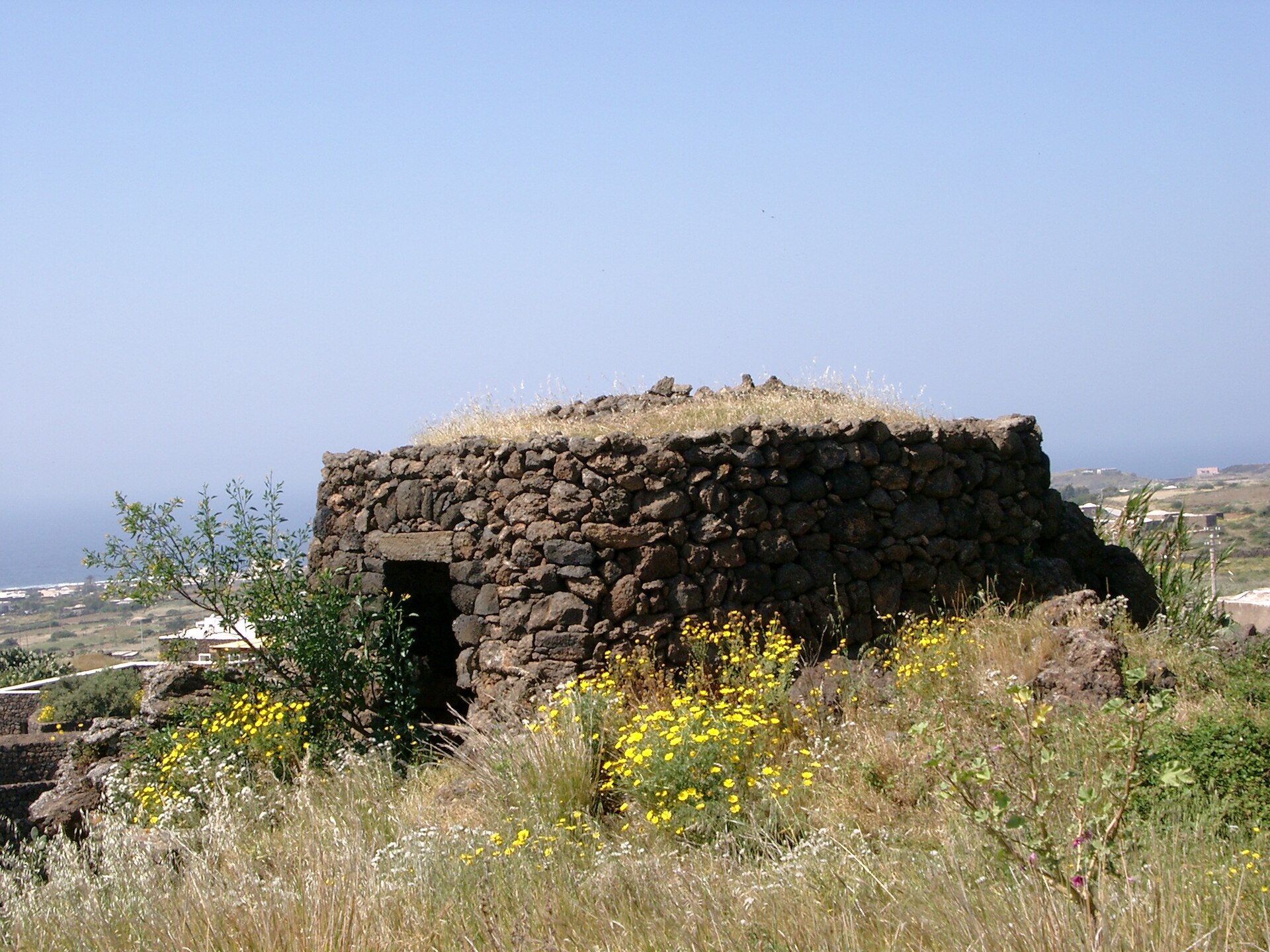

What exactly is a dammuso?
A single-storey house built dry from local lava stone, with very thick walls, small deep-set windows and a shallow white dome on top. The dome is not decoration: it is a rainwater catchment, sloped and plastered so that what little rain falls runs into a cistern beside the house. On an island with no rivers and no springs of drinkable water, that cistern was the point.
The thermal mass does the rest. Thick stone absorbs heat all day and releases it at night, so the rooms stay cool through summer and mild in winter with no air conditioning at all. Most rentals now add it anyway, but you will often find you do not need it.
The same logic shapes the giardino pantesco you will see beside many dammusi: a circular dry-stone enclosure, often several metres high, built to shelter a single citrus tree from the wind. It is the same idea as the island’s vines, which are grown in hollows for exactly the same reason.
Which area should you choose?
The island is small but slow: the perimeter road takes about 45 minutes without stops, and everything is up or down a narrow lane. Where you sleep decides how much of your week you spend driving.
- The east — Tracino, Khamma, Gadir. The prettiest coast and the best swimming: Cala Levante, Cala Tramontana, the Arco dell’Elefante and the thermal pools at Cala Gadir. Quiet, scenic, and a long way from the airport — see the beaches guide for what is worth the drive.
- The south-west — Scauri, Rekhale. A working village with a harbour, restaurants and a bar or two, plus Sataria Cave nearby. The best compromise between remoteness and being able to buy bread, with restaurants and a couple of bars in walking distance.
- The north — Mursia, Karuscia. Closest to town and the airport, sunsets over the sea, and the coast at Cala Cinque Denti.
- Inland — Bukkuram, Sibà, the Montagna Grande slopes. Vineyards, silence and the best stars. You will drive to every swim, but the Montagna Grande trails start at the door and the cellars are minutes away.
Dammusi Sciuvechi
A small resort of dammusi on the Sciuvechi slope, one of the established names on the island and among the easiest to book directly. Separate units with their own outdoor space, the usual thick-walled cool interiors, and a position that works for both coasts.
Contact. Via Sotto Coste di Sciuvechi 18, 91017 Pantelleria (TP) · +39 338 970 7429 · [email protected] · dammusisciuvechi.it ↗
Dammusi Al-Qubba Wellness & Resort
Nine dammusi, each different and each named after a wind, set in about three hectares of Mediterranean garden near the airport and within reach of town. The distinguishing feature is the wellness area: a saline bio-sauna, an emotional shower, indoor and outdoor relaxation space, and massages by arrangement.
It is the most hotel-like of the dammuso options — useful if you want self-catering independence without giving up services entirely.
Contact. Via Madonna della Margana 19, 91017 Pantelleria (TP) · +39 349 315 4621 · +39 346 187 8226 · [email protected] · al-qubbaresort.com ↗
Dammusi & Relax
Dammusi to rent at Campobello, on the island’s western side. A straightforward family-run operation rather than a resort, and one that answers on several numbers — call rather than email if you want a quick reply in season.
Contact. Via Campobello 151, 91017 Pantelleria (TP) · +39 329 217 7503 · +39 380 282 9399 · +39 333 431 6910 · [email protected] · dammusierelax.com ↗
Dammusi Uliveto
Dammusi set among olive trees, rented directly by the owners. Simple, quiet and the kind of place where the person who hands you the keys also tells you which cove is sheltered today.
Contact. Via Rizzo 31, 91017 Pantelleria (TP) · +39 331 774 0622 · [email protected] · dammusiuliveto.it ↗
Dammuso Il Mulino
A large dammuso managed by DomuSicily, with five bedrooms and five bathrooms, a pool with a view, garden, outdoor fireplace and barbecue — built for a group or an extended family rather than a couple. The beach at Sataria is a short walk and the airport is only a few kilometres away.
Note the name: there is a separate, unrelated property called Il Mulino di Scauri on the same island. Check you are booking the right one.
Contact. Managed by DomuSicily · domusicily.com ↗ · also listed on the major booking platforms
Perla Nera — I Dammusi di Scauri
A group of dammusi on the Strada Perimetrale in Contrada Penna, a couple of kilometres from Scauri and close to the airport. Units have air conditioning, private bathrooms, kitchenettes, terraces and sea views, with a sundeck and garden shared between them.
It is booked through the rental platforms rather than a direct site, which in practice means you can see live availability — useful in August.
Contact. Strada Perimetrale, Contrada Penna, 91017 Pantelleria (TP) · listing and availability ↗
Staying in Bukkuram and around Kuddia
Inland on the eastern side, Bukkuram and the Kuddia hills are vineyard country — this is where Marco De Bartoli’s Bukkuram estate sits — and the dammusi here are scattered among terraces rather than clustered on a coast road. You trade beach access for silence, night skies and being five minutes from a cellar door.
Several separate properties rent in this area, among them La Kuddia, I Dammusi di Sotto Kuddia and Dammuso Bukkuram. They are small, independently run and mostly listed on the booking platforms rather than through their own sites, so search by property name and check the exact contrada before you commit — the names are similar and the addresses are not.
From here the craters and favare and the Punta Spadillo trail are both easy to reach, and cooking classes often run at the nearby estates.
Breathtaking-view dammuso, Scauri
A privately let dammuso above Scauri on the south-west coast, booked through Airbnb. The draw is the position and the view over the water towards Africa; the trade-off, as with most dammusi on this side, is a steep lane to get to it.
Sea-view dammuso
Another privately let dammuso with a sea view, again on Airbnb. Direct listings like these are often the best value on the island outside the resorts, and the hosts tend to be islanders who will tell you where to eat.
What does a dammuso cost?
There is no fixed rate card to quote. Dammusi are rented by owners and small managers through their own sites and the booking platforms, priced dynamically, and the same house can triple between June and mid-August. Anyone publishing a nightly figure in a guide is guessing.
What is reliable is the shape of it: weekly lets are the norm and cheaper per night than short stays; August, and Ferragosto week around the 15th in particular, is both the most expensive and the first to sell out; and June and September cost far less for a sea that is just as warm. Many owners set a minimum stay in high season. Check dates directly on the links above.
Before you book
- Water comes from a cistern. It is not unlimited and on many properties it is not drinkable — buy bottled for drinking and treat showers as a resource. Ask the owner how the supply works.
- You will need a vehicle. Almost every dammuso sits up a lane with no bus and no shop. See our car and scooter rental guide.
- The lanes are narrow and unlit. Dry-stone walls on both sides, no barriers, and no street lighting at night. A small car is easier than a large one.
- Shop before you drive up. Villages have small alimentari with limited hours; there is no supermarket open late. Our food and drink guide covers what is worth buying locally.
- Check what is included. Final cleaning, linen, air conditioning and pool use are sometimes extra. Ask before booking rather than at check-out.
From your door
The point of a dammuso is that the island starts at the doorstep. Soak at the Lago di Venere, sweat in the steam cave at Bagno Asciutto, or walk out to the Favare Grande where the steam comes out of the hillside.
Swim at Cala Nikà, where hot water meets the sea, or make the rough descent to Balata dei Turchi. Dive with Green Divers or Pantelleria Divers. Ride, cycle or walk with the operators in our outdoor guide, including the island bike options.
If self-catering starts to feel like work, Amuni, the restaurant of the agriturismo Parco dei Sesi, is open to non-residents by booking, and the restaurant at Pantelleria Dream Resort is open to non-residents. Arriving by sea, the Trapani hydrofoil docks in town; see getting to Pantelleria for the alternatives, and the boat operators for a day at sea.
Dammusi in Pantelleria: questions answered
A traditional Pantelleria house: a low single-storey building of black lava stone with walls about a metre thick and a shallow white dome on top. The dome is a rainwater catchment feeding a cistern, and the thick stone keeps the interior cool through summer without air conditioning.
There is no fixed rate to quote: dammusi are priced dynamically by owners and platforms, and the same house can triple between June and mid-August. Weekly lets are the norm and cost less per night than short stays. Check live availability on the property listings rather than trusting a published figure.
The east around Tracino, Khamma and Gadir for the best swimming and scenery; Scauri in the south-west if you want a village with shops and restaurants; the north near Mursia for proximity to town and the airport; and inland Bukkuram or Sibà for vineyards, silence and dark skies.
Yes, but it comes from a rainwater cistern rather than mains supply, it is not unlimited, and on many properties it is not drinkable. Buy bottled water for drinking, keep showers short, and ask the owner how the supply and any top-ups work before you arrive.
Almost certainly. Most dammusi sit up narrow unlit lanes with no bus service, no shop and no restaurant within walking distance. A small car handles the dry-stone lanes better than a large one, and you should shop for supplies before driving up for the evening.