Last updated: July 2026
The Parco Nazionale describes Pantelleria as un centro termale a cielo aperto — an open-air spa. It is not marketing. The island is the emerged tip of an active volcanic complex, roughly 28% above water and 72% below it, and while the last eruption on land was around 7,000 years ago, the system underneath is still very much alive. What surfaces today is secondary volcanism: fumaroles, steam caves, and hot springs that come up through the seabed and the lake floor.
All of it is free and none of it is supervised. There are no spa staff, no ticket desks, no thermometers on the wall. Several of these sites are designated geosites under Sicilian regional decree, which means they are protected rather than developed. This page covers the seven main places where you can feel the volcano, and how to use them without hurting yourself or the site.
- Lago di Venere · Gadir · Nikà · Sataria
- Bagno Asciutto di Benikulà · Favara Grande · Scauri Scalo and the rest
How hot does the water actually get?
Hot enough to injure you. At Nikà the thermal spring emerges between 85 and 100 °C, and where it first meets the sea it can still be around 70 °C before it disperses. Sataria runs near 40 °C, Benikulà’s steam arrives at about 38 °C, and Gadir’s rock basins vary from bath-warm to too hot to enter.
So the rule everywhere on this page is the same one the islanders use: test with a hand before you put a body in, and never lower yourself into a pool you have not touched. The temperature changes from one rock bowl to the next, and it changes through the day with the tide and the swell. What was pleasant yesterday afternoon may not be this morning.
Two more things worth internalising. Keep soaks short — ten to fifteen minutes is what people who use these sites regularly do, not an hour. And use no soap, shampoo or scrub anywhere: at every one of these sites the water drains straight into the sea or into national park soil.
Lago di Venere (Bagno dell’Acqua)
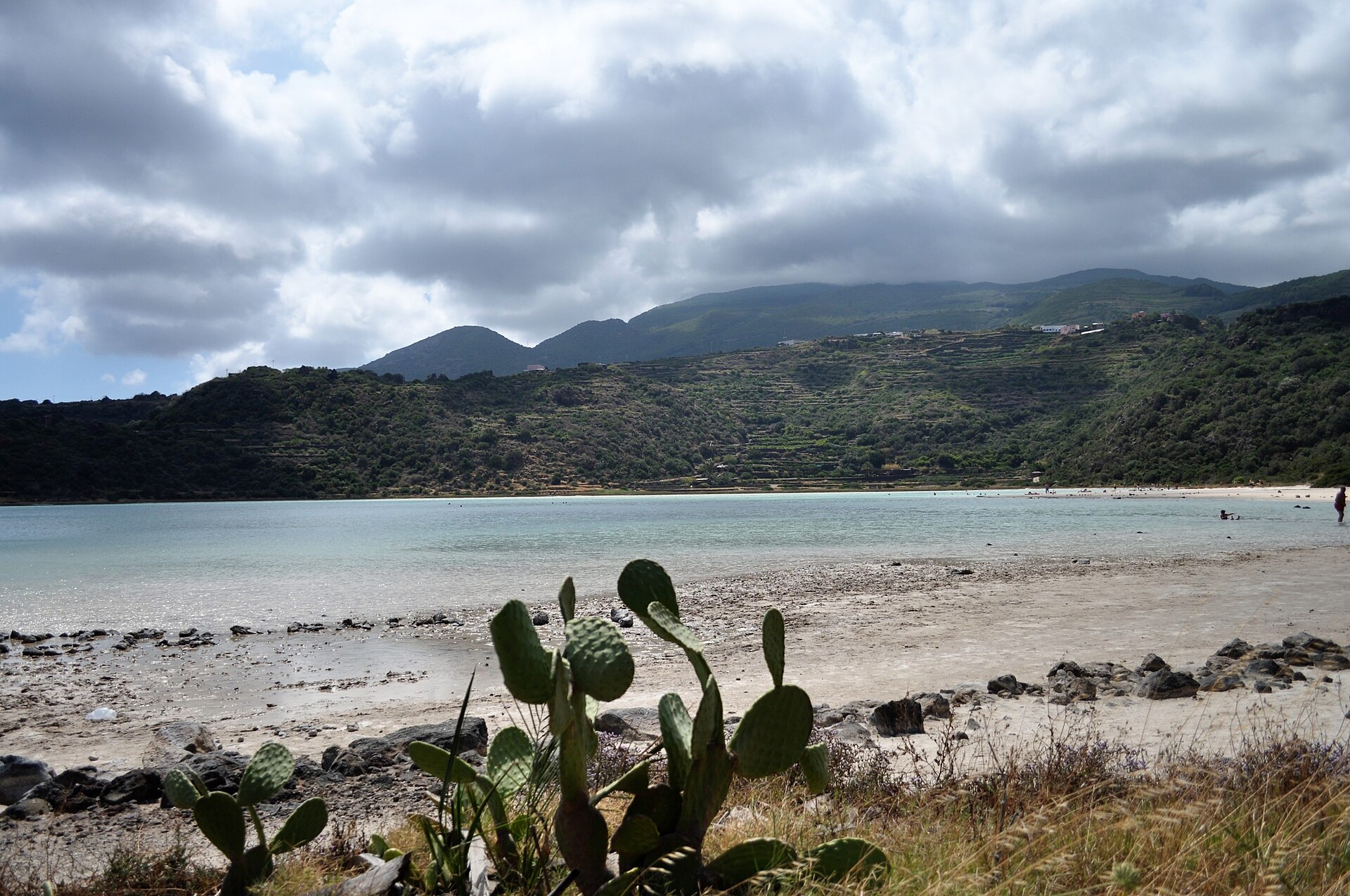

A shallow lake in an old crater in the north of the island, fed by three thermal springs, with a shore of fine pale mud that people have been coating themselves in for centuries. It is the gentlest thermal experience on Pantelleria and the only one with an easy walk-in entry — no ladders, no scrambling, no cliff path.
It is also an ecosystem with no equivalent anywhere, built up over millennia by photosynthetic cyanobacteria working alongside the hydrothermal springs. That is why it is regulated more tightly than anywhere else on the island.
Municipal ordinance no. 95 of 29 June 2023 governs what happens here. Banned: motor vehicles and bicycles at the lakeside, umbrellas and deckchairs, canoes, surfboards and paddleboards, tents, open fires, walking on or picking the shoreline vegetation, leaving waste, and spilling anything solid or liquid into the water or onto the ground. Laying towels or clothing on the vegetation around the lake and along the shore is also prohibited. A restricted-traffic zone applies on the approach.
The mud is still allowed. The park directorate has been explicit about it: treatments continue, within the cautions the ordinance sets. Scoop it, spread a thin coat, let it dry, then rinse in the shallows. Do not dig into the bank to get it, and take nothing away with you.
There is nothing at the lake — no kiosk, no toilets, no shade — so bring water and a hat and leave with everything you arrived with. Spring and autumn are the best months, and early morning is the best hour. The lake also appears in our guide to the island’s coves and swimming spots, and there is a walk around the crater rim in our outdoor guide.
Gadir
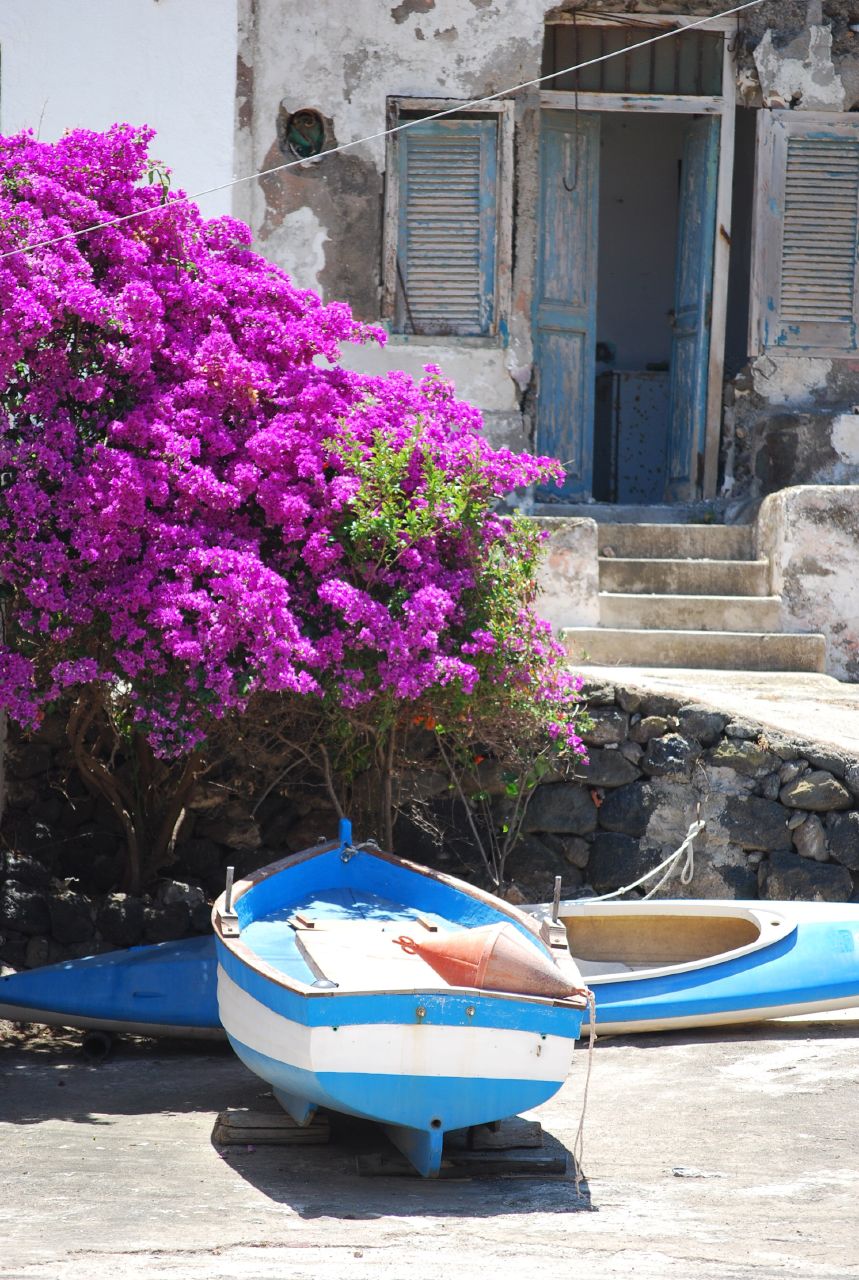

One of the best-known contrade on the island: a fishing hamlet on the north-east coast with a slipway for hauling boats, and thermal basins of varying size and temperature set into the rock right at the waterline. It is the most accessible geothermal bathing on Pantelleria, and the one that works year-round.
There is history in the water here beyond the heat. Until the 1960s Gadir was rich in buvire — freshwater wells — which were used to supply passing ships. The hot basins are what remain in use today, and they are entirely public: you arrive, you find a bowl that suits you, you get in.
The temperatures differ from one basin to the next, so this is exactly where the hand test matters. Bathers mix in cooler seawater to bring a pool down to something comfortable. The routine most people settle into is a short soak, a swim out into the harbour to cool off, and back again.
Parking is limited roadside, so come early in July and August. The East Coast bus line serves this side of the island. Gadir is also a fine snorkel and a dive site — see our cove guide and the diving centres — and Cala Karuscia is a few minutes north for an easy swim.
Nikà
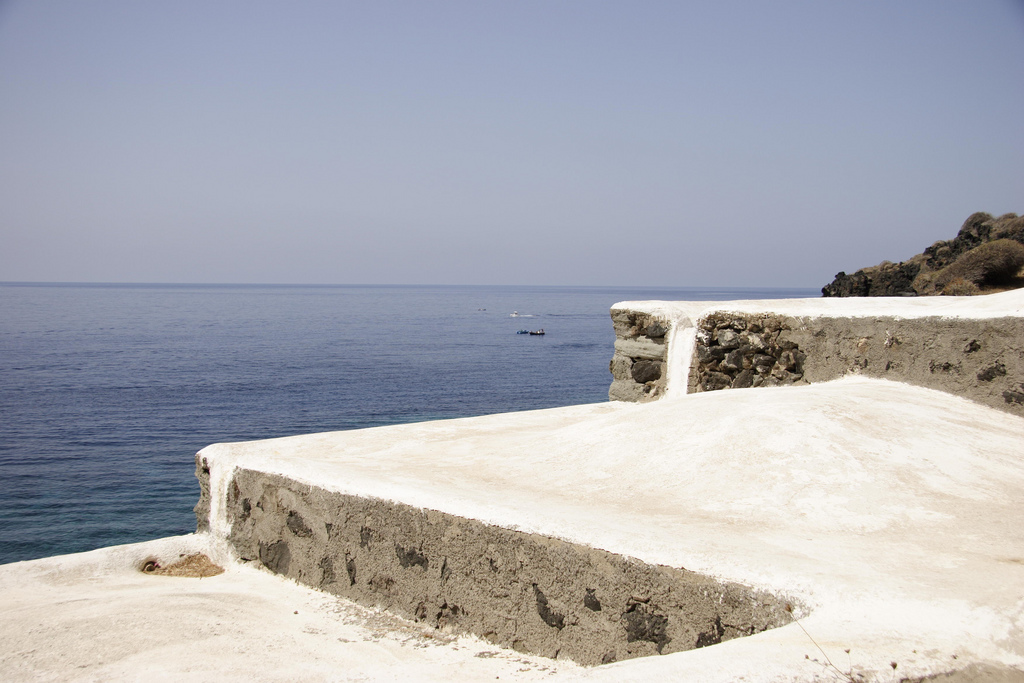

A descent to the sea on the island’s southern coast, and the most spectacular of Pantelleria’s thermal sites — also the one that demands the most respect. Hot water comes out of a small inlet beneath the rock face, and small natural basins bounded by rocks let you sit in it, with sulphur, hydrated silica and alum crusting the stone around you in yellows and whites.
Read this before you get in. The spring emerges at between 85 and 100 °C. Where it mixes with the sea it reaches around 70 °C, and only further out does it settle to the just-above-40 °C that makes for a good soak. That is scalding water arriving at a place with no supervision and no signage at the pools themselves. Work outward from the cool end, test everything with a hand, and keep children back from the inlet entirely.
Handled properly it is remarkable: you can sit in warm water on a wild lava coast in November with nobody else there. The site is reachable on foot from the road above or from the sea, and the walk down is a stepped path over loose volcanic rock — proper shoes, and not somewhere to carry much.
There are no facilities of any kind. Bring drinking water and a towel you do not mind staining. Phone signal is unreliable at the water. Many people see this coast more easily from a boat, and Balata dei Turchi is along the same stretch.
Grotta di Sataria
A sea cave on the south-west coast, just before Scauri, known since antiquity for the quality of its water. Inside, hot springs at around 40 °C feed three basins cut into the rock, and the overflow runs out to meet the sea at the mouth of the cave.
The name tells you what it was for. Sataria comes from the Greek Soterìa — the grotto of health. The water has been used for arthritis and rheumatic pain for as long as there are records of it, and it is still used that way by islanders today.
Of all the sites here this is the most contained and the most companionable: a low chamber, warm water, and a flat lava apron outside where you can cool off in the open sea. Steps lead down from the road. Bring a torch if you are going late in the day, wear something with grip because the rock inside is wet and algae-slicked, and keep your voice down — the acoustics carry and people come here to be quiet.
No facilities. Scauri is a few minutes away for a coffee or a meal afterwards — see our restaurants guide — and the South-West bus line covers this coast.
Bagno Asciutto di Benikulà
The island’s natural sauna, and the strangest thing on this page. In the Sibà district, along the flank of Montagna Grande, a natural cave opens in a large fault. It has been divided since ancient times into two rooms: an outer chamber — the frigidarium — looking out over the great plain of Monastero and lined with the traditional stone seats islanders call dukkéne, and a smaller inner chamber where water vapour arrives at around 38 °C.
Panteschi and visitors alike use the inner room exactly as a sauna, for rheumatic pain. You sit on the warm rock, the steam gathers, and after ten minutes or so you step out into the outer chamber and one of the finest views on the island. The alternation is the whole point, and the two-room layout that somebody cut centuries ago is what makes it work.
Ten to fifteen minutes inside is enough. Bring water — steam dehydrates faster than you expect — and a towel to sit on. Anyone with asthma or a heart condition should think carefully: the vapour carries volcanic gases. The park runs an info point at the site, and the cave sits on the network of Montagna Grande trails, so it combines naturally with a walk rather than a drive.
Favara Grande
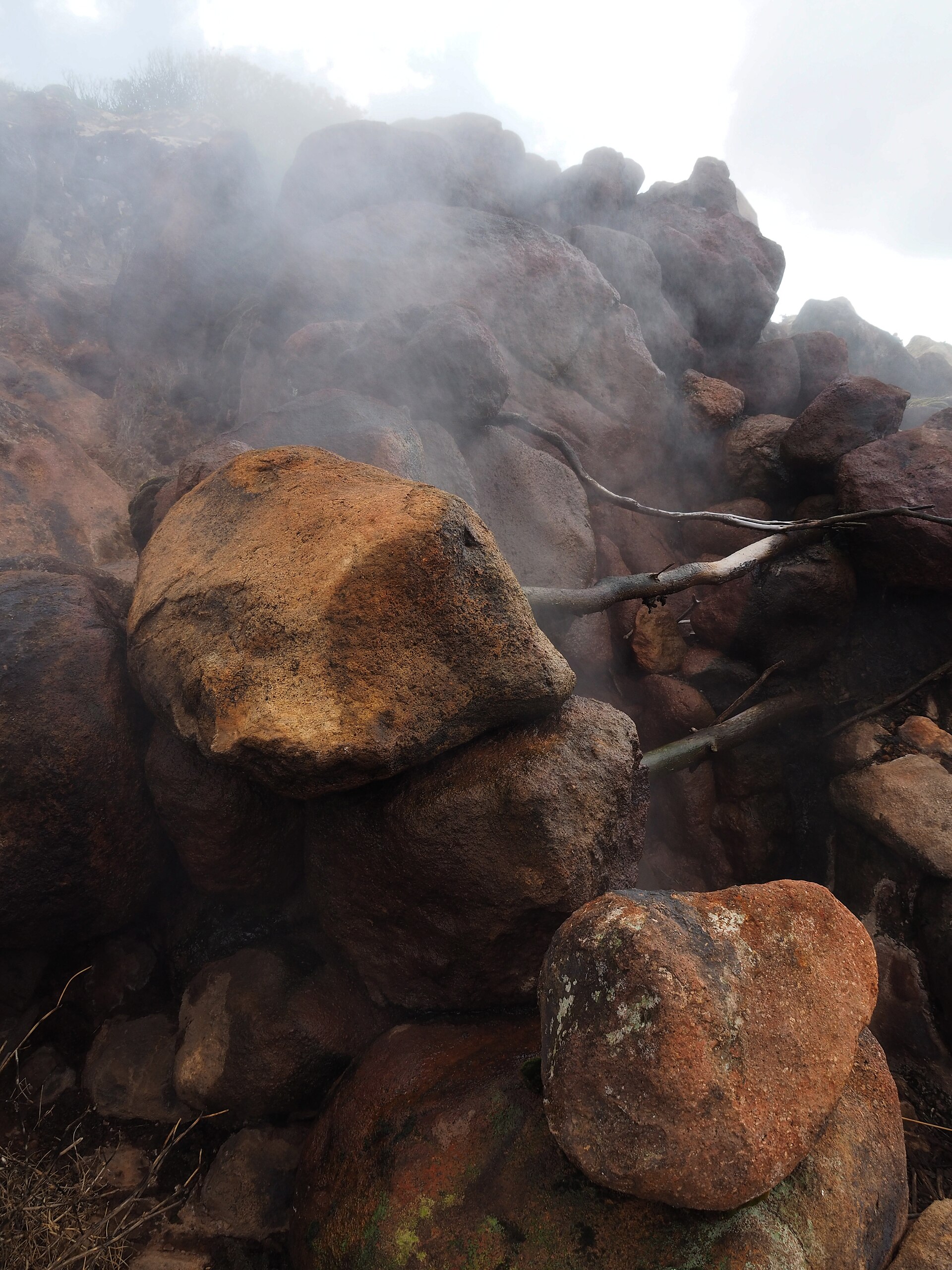

Favara is the Pantescan word for a fumarole, and Favara Grande is the largest of them: a designated geosite on the southern slope of Montagna Grande, at around 450 metres, where steam vents intermittently from fissures in the rock along with sulphur dioxide and hydrogen sulphide. You often hear it before you see it.
This is not a bathing site. It is the clearest evidence on the island that the volcano is still working, and it is worth the walk for that alone. There is a detail here that says a great deal about how people lived on a waterless island: the condensation from the fumarole steam was historically collected in small basins carved into the rock, and used to water grazing animals.
Two ways in. The Costa della Favara path follows an old route to the Passo del Vento, from which Favara Grande is immediately visible. Alternatively trail 971 climbs from the Benikulà sauna towards the Fossa del Russo, with the favare in view along the way — which lets you combine the steam cave and the fumarole field in one outing.
The ground near active vents is hot and can be unstable, and the routes are not always obvious, so this is the one place on this page where a guide genuinely helps. Our craters and favare section lists operators who run it, and the Zighidì loop takes in the same ground.
Scauri Scalo, and where else the heat comes up
The six sites above are the famous ones, but they are not the whole story. The park notes that Scalo di Scauri — the little harbour below the village, and the site of the island’s Phoenician port — has a situation much like Gadir’s, with thermal water surfacing among the rocks at the shore.
That is the pattern across Pantelleria. Hot springs and fumaroles are scattered all over the island, concentrated along the local volcano-tectonic lines, which is why you can be walking a caper terrace and feel warm air coming out of the ground. Some of these spots have names and some do not; islanders know them, and they are not signposted.
Which is the argument for not treating this page as a checklist. If you are staying a week, pick two or three sites and go back to them at different hours rather than driving between all seven. The water is better at dawn, the light is better at dusk, and the sites are quietest when the day-trippers are at lunch. Where you sleep shapes this more than anything — see our guides to dammusi and where to stay, and to renting a vehicle, because none of these places is walkable from town.
When is the best time for the thermal sites?
Spring and autumn, and the shoulder months beat high summer comfortably. March to June and late September through November give you air in the low twenties, water that is still hot, and the sites largely to yourself. In August the appeal of sitting in 40 °C water at midday is limited, and everywhere is busy.
Winter is the island’s secret here. The springs do not cool down because the sea does, so a soak at Gadir or Sataria in January is one of the best things you can do on Pantelleria — pack a robe and something hot to drink for afterwards. Access is the constraint: outside summer you are down to the year-round flights from Sicily and the ferry, covered in our guide to getting to Pantelleria.
Whatever the season, go early or go late. Everything on this page is better without a crowd, and most of it is on rock that bakes through the middle of the day. For the rest of what the island offers, see our guide to things to do in Pantelleria.
Yes, all of them. Lago di Venere, Gadir, Nikà, Sataria, the Benikulà steam cave and Favara Grande are public and free, with no ticket desks and no staff. That also means no supervision, no lifeguards and no thermometers — you judge the water yourself, and several sites are protected geosites where conduct is regulated.
The spring emerges between 85 and 100 °C. Where it mixes with seawater it can still reach around 70 °C, settling to just over 40 °C further from the inlet. That is hot enough to scald at an unsupervised site, so test every pool with a hand before entering, work outward from the cool end and keep children away from the inlet.
A natural steam sauna in a cave on the flank of Montagna Grande, in the Sibà district. It has two chambers: an outer frigidarium with stone seats called dukkéne looking over the plain of Monastero, and an inner room where volcanic vapour arrives at about 38 °C. Islanders have used it for rheumatic pain since ancient times.
Yes. The park directorate has confirmed mud treatments continue, within the cautions of municipal ordinance no. 95 of June 2023. The ordinance bans umbrellas, deckchairs, canoes, surfboards and paddleboards, tents, fires, bicycles and motor vehicles at the lakeside, and laying towels or clothes on the shoreline vegetation. Use no soap or shampoo.
Spring and autumn — March to June and late September through November — when the air is in the low twenties and the sites are quiet. Winter works too, because the springs stay hot while the sea cools, though access narrows to the year-round flights from Sicily and the ferry. August is the worst month: hot, crowded and uncomfortable on the rock.